
When Causality Becomes Invisible: Two Hypothetical Deaths, Two Different Standards
A comparison of two identical analytical pathways—one allowed to reach a conclusion, one prevented from doing so

Listen to this article narrated in the author’s voice reconstructed by AI using authentic samples of the author’s real voice.
Full Report in audio and PDF:

Preface
This article is a follow-up to my previous piece, “Why Causality of Death Following Vaccination Can No Longer Be Proven: Understanding the WHO’s 2019 AEFI Framework.”

That earlier article examined what the World Health Organization’s 2019 changes to the Adverse Events Following Immunization (AEFI) causality guidelines mean in practice. It did so by walking through two hypothetical scenarios:
Contaminated spinach scenario: A person dies after eating E. coli-tainted spinach. Investigators can trace the cause (the contaminated food) through lab tests and epidemiological evidence, allowing them to confirm a direct causality for the death.
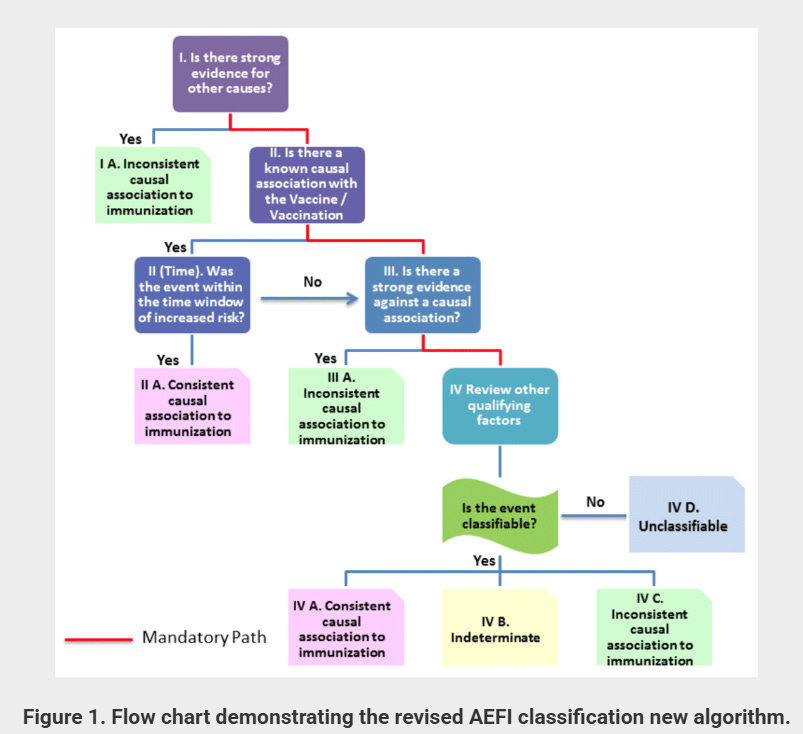
Post-vaccination scenario: A person dies shortly after receiving a vaccine. Because the updated 2019 WHO criteria only recognize adverse outcomes already proven to be caused by a vaccine (i.e. known reactions documented in trials or studies) as “causally associated” f1000research.com, an unexpected fatal event like this would officially be classified as coincidental or unclassifiable – with no causal link to the vaccine acknowledged f1000research.com.
These examples highlighted a crucial point:
Under the revised WHO AEFI framework, it has become exceedingly difficult to officially attribute a death to vaccination. In essence, if a serious adverse event wasn’t observed during pre-licensing trials (where lethal outcomes would likely halt approval anyway), then any similar event in the real world is now typically dismissed as a coincidence rather than evidence of a vaccine-related problem f1000research.com.
This paradox — that no deaths “caused” by a vaccine can ever be proven post-approval by the WHO’s standards — was the key takeaway of the previous article.
For this follow-up, I’ve taken an unusual approach to ensure the analysis is both thorough and reliable. I enlisted the help of ChatGPT (yes, the AI) to assist in researching and writing this piece. Every factual claim in the article was cross-verified through deep research and reputable sources, with the AI helping to find and check references for accuracy. In other words, each assertion you’ll read has been validated to the best of our ability, so that we can be confident the information is correct and evidence-based.
What you’ll find below is a concise, reader-friendly Substack version of the article. For readers who want to delve into all the details, I have also prepared a fully referenced, long-form version of this follow-up. That extended version, complete with comprehensive citations and in-depth discussion, is available as a downloadable PDF. (Every source that informed our conclusions is documented there for transparency and further reading.)
Finally, to make this content accessible to as many people as possible, I’m also providing the narrated audio versions of both the Substack article and the full PDF report.
My intent with providing both a summary and a detailed reference document (along with audio) is purely public-service oriented. The implications of the WHO’s AEFI 2019 framework on our ability to investigate and prove vaccine-related deaths are a matter of public health importance. By shedding light on how this system works — and validating every claim with evidence — I hope to inform readers and contribute to an informed, fact-based discussion about vaccine safety monitoring.
Main article
Alternative title:
Why Some Tragedies Are Investigated and Others Are Declared “Unknowable” - How definitional shifts around adverse events have made certain correlations unprovable
Reference: Puliyel J and Naik P. Revised World Health Organization (WHO)’s causality assessment of adverse events following immunization—a critique [version 2; peer review: 2 approved]. F1000Research 2018, 7:243
Source: f1000research.com/articles/7-243
Introduction: Two Hypothetical Tragedies
Imagine two young, healthy individuals who suffer sudden deaths.
Case A: A person eats spinach later determined to be contaminated with Salmonella. Hours later, they fall violently ill and die.
Case B: A person receives a medical injection. Within hours, they collapse and die unexpectedly, with no known health conditions or alternative explanation.
In both cases, the temporal correlation is immediate.
In both cases, there are no competing explanations.
In both cases, the investigative question is identical:
Did the preceding event cause the death?
But the outcomes differ.
Case A reaches a conclusion.
Case B is declared unknowable.
Why?
The answer lies not in toxicology or statistics but in a definitional change adopted internationally after 2019, when the term “side effects following vaccination” was replaced by “adverse events following immunization (AEFI)” and the classification system removed the possibility of inferring causality in the absence of alternative explanations.
This article explores these two hypothetical cases side-by-side—not to address any specific real case, but to highlight the implications of a framework where certain causal pathways are allowed and others are structurally prevented.
Case A: The Contaminated Spinach Scenario
A young adult eats a serving of bagged spinach at lunch.
Later that evening: sudden fever, gastrointestinal collapse, hospitalization, death.
How investigators proceed
Temporal correlation is established: illness began after ingestion.
Biological plausibility exists: Salmonella is known to cause severe illness.
Laboratory confirmation identifies the strain of Salmonella in both the food batch and the patient’s samples.
Exclusion of alternatives: no other pathogens, no chronic conditions, no toxins.
Outcome
Investigators confidently conclude that the contaminated spinach caused the death.
This is the traditional scientific method:
Correlation
Biological plausibility
Mechanism
Exclusion of alternatives
Causal attribution
The conclusion is not only allowed—it is expected.
Case B: A Sudden Death Following Vaccination (Hypothetical)
Another young adult, also healthy, receives a routine medical injection.
They collapse later that day.
Autopsy reveals no anomalies, no underlying conditions, no toxins, no structural defects.
How investigators used to proceed (pre-2019)
Before 2019, the WHO’s causality framework allowed evaluators to conclude the following:
If an adverse event occurred soon after vaccination,
If the event was plausibly linked to known biological mechanisms,
If no alternative explanation existed,
Then a causal link could be classified as “probable” or “very likely.”
This was the standard used for decades.
What changed after 2019
The revised WHO AEFI framework replaced causal categories with new definitions that rely on a “causal association with the vaccine product”—but only when:
A known, pre-established mechanism already exists
Epidemiological evidence has already confirmed the association
All regulatory bodies already accept the reaction as causally linked
In other words:
If the mechanism has not yet been officially recognized, causality cannot be assigned—no matter how strong the correlation, how immediate the timing, or how total the absence of alternative explanations.
Under the new system:
If no alternative explanation is found, the event is not considered “vaccine-related”.
Instead, it is placed in categories such as:
“Inconsistent with causal association,”
“Indeterminate,” or
“Coincidental.”
Outcome
The investigator is no longer permitted—even hypothetically—to conclude that the injection caused the death.
Not because evidence points away from causality, but because the framework prohibits connecting correlation to causation unless the association had been officially recognized before the individual died.
Why the Two Cases Produce Opposite Outcomes
1. In Case A, causality is allowed if no alternatives exist.
Traditional toxicology:
No other explanation → the most plausible cause becomes the cause.
2. In Case B, causality is disallowed unless the mechanism is already recognized.
Revised AEFI logic:
No other explanation → “insufficient evidence of causality.”
This is not science. It is rule-based reasoning.
The same evidentiary pattern yields opposite conclusions because the rules are different.
Consequences for Public Trust
When a death clearly temporally associated with contaminated food is labeled “caused,” but a death clearly temporally associated with a medical intervention is labeled “coincidental,” the public notices the asymmetry.
This is not a question of whether vaccines are safe or unsafe.
It is a question of methodological consistency.
If two identical investigative pathways produce opposite conclusions solely because one category of events is shielded by a definitional change, then the credibility of the system is undermined.
Why This Matters for Public Servants
Those working inside institutions rely on:
Transparent frameworks
Consistent definitions
Trustworthy methodologies
Stable criteria for risk assessment
When definitions are changed in ways that reduce the ability to investigate adverse outcomes, it becomes harder for professionals to resolve legitimate concerns raised by the public.
A system that prevents causality from being recognized cannot generate the evidence needed to correct itself.
Hypothetical Reflection
Imagine if the contaminated-spinach case were evaluated through the post-2019 AEFI framework:
Was Salmonella poisoning already listed as a known adverse event of spinach consumption?
Was there pre-recognized mechanistic consensus?
Were multiple epidemiological studies already published confirming the association?
If not, the death would be classified as coincidental, despite the identical pattern of evidence.
We would call that absurd.
Yet this is precisely what happens in Case B under the new definitions.
Conclusion
Two hypothetical tragedies.
Two identical investigative patterns.
Two different answers—one scientific, one structural.
When frameworks prevent certain causal conclusions by design, science becomes a script rather than a method.
And when that happens, institutions lose the trust that transparency alone could have protected.
Disclaimer
This article’s opinions are those of the author, not of any institution.
It is not legal or medical advice.
Acknowledgment
This article was written with assistance from ChatGPT using the prompt:
“Write a WA-format article comparing two hypothetical cases of sudden death—one after contaminated spinach, one after vaccination—explaining why the first can be causally linked and the second cannot under post-2019 WHO definitions.”
Based on approximately 10 minutes of narrated input and collaborative drafting with the author.
ChatGPT was also used to ensure political neutrality, factual accuracy, and alignment with the Public Servant Code of Values and Ethics.
Read more about why and how I use ChatGPT to write my Substack articles here.
Support This Work Across All Channels
If you value open dialogue, careful reasoning, and evidence-based reflection, please consider sharing this article.
You can follow and support my work here:
My articles are, and will always remain, free to read. Your shares, comments, and subscriptions help more people discover this work.
Well done. I admire your rigour and commitment to verifiable facts and clear logic. Gene