
Unmasking Political Interference in Health Policy. Part 3: From Diagnosis to Action - My Plan to Counter Political Interference in Public Service
A methodological roadmap for addressing scientific integrity in departments that develop health policies and regulate market products

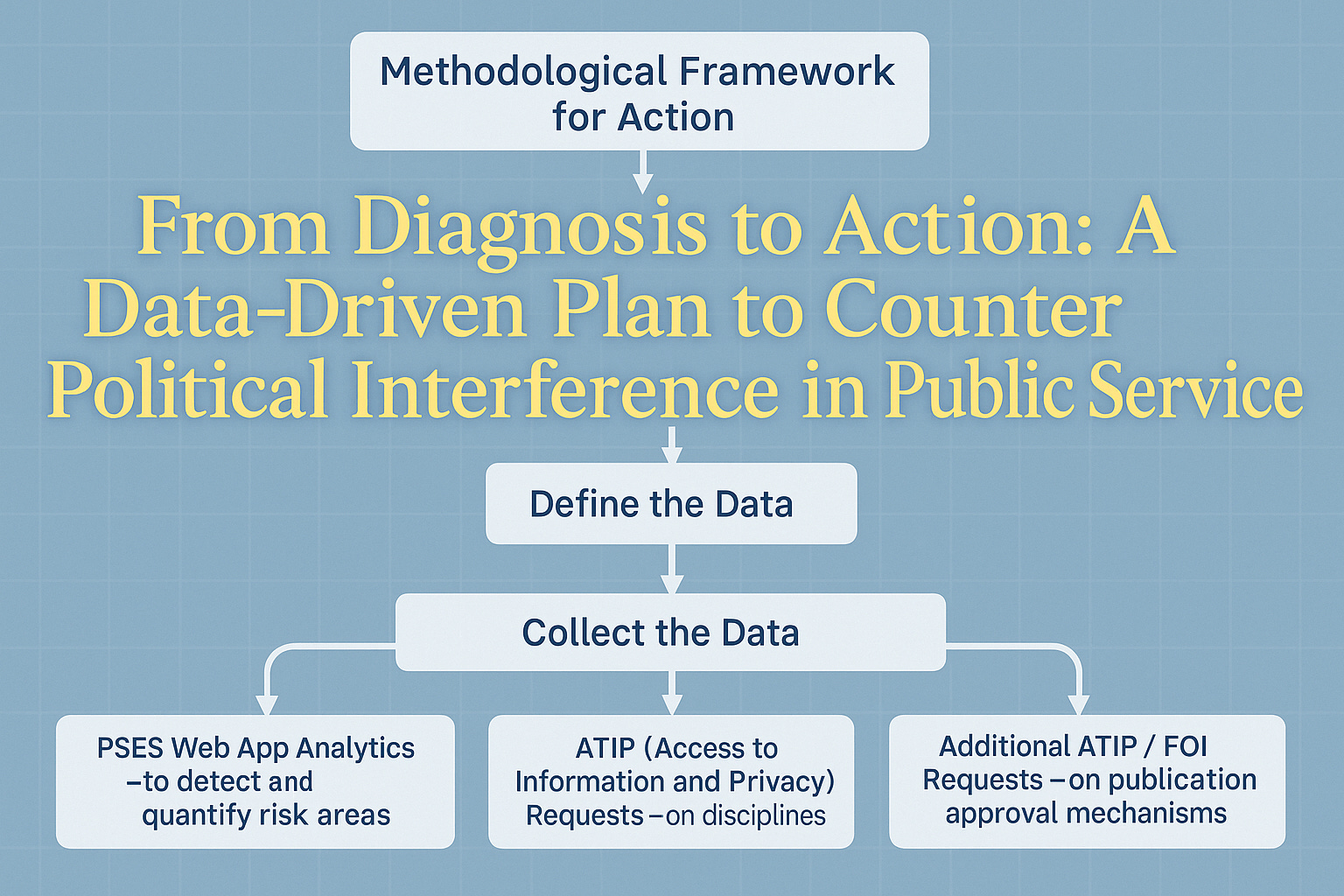
Introduction
In the first article of this series, we identified the seed of political interference—large private foundations and industrial networks whose funding shapes the global policy agenda.
In the second, we traced the branches and pillars of that influence—propaganda, censorship, policy synchronization, behavioral control, and data manipulation.
We now arrive at the third and most important step: moving from diagnosis to action.
As a public servant, scientist, and union member nominated for PIPSC executive positions, I am committed to addressing this problem through a methodological, evidence-based approach—the same analytical discipline I apply in research and data science.


Problem Restated: The Impact on Public Service Integrity
Public service professionals are increasingly constrained in their ability to provide recommendations based purely on science.
Instead, many face top-down pressure to align with politically or industrially guided agendas.
The result is a growing divide between scientific truth and policy communication, creating conditions where integrity becomes a liability rather than a virtue.
The fear of reprisal—discipline, isolation, or reputational damage—has become a silent but pervasive force within government workplaces.As my experience since being elected to the NCR PIPSC Executive and running for the Vice-President position last year shows — after preparing multiple resolutions and motions, most of which never even reached the discussion stage — our union has demonstrably shown an absence of interest in addressing, or even acknowledging, this problem.
Hence, the responsibility to act falls on those of us who still believe in ethical governance and transparent evidence-based policy—on me in particular, as I am honoured to be in this privileged position, nominated and supported by hundreds of PIPSC members who placed their trust and votes in me.
Methodological Framework for Action
Drawing from data-science principles, I propose to treat this issue as a systemic process that can be analyzed, measured, and re-engineered.
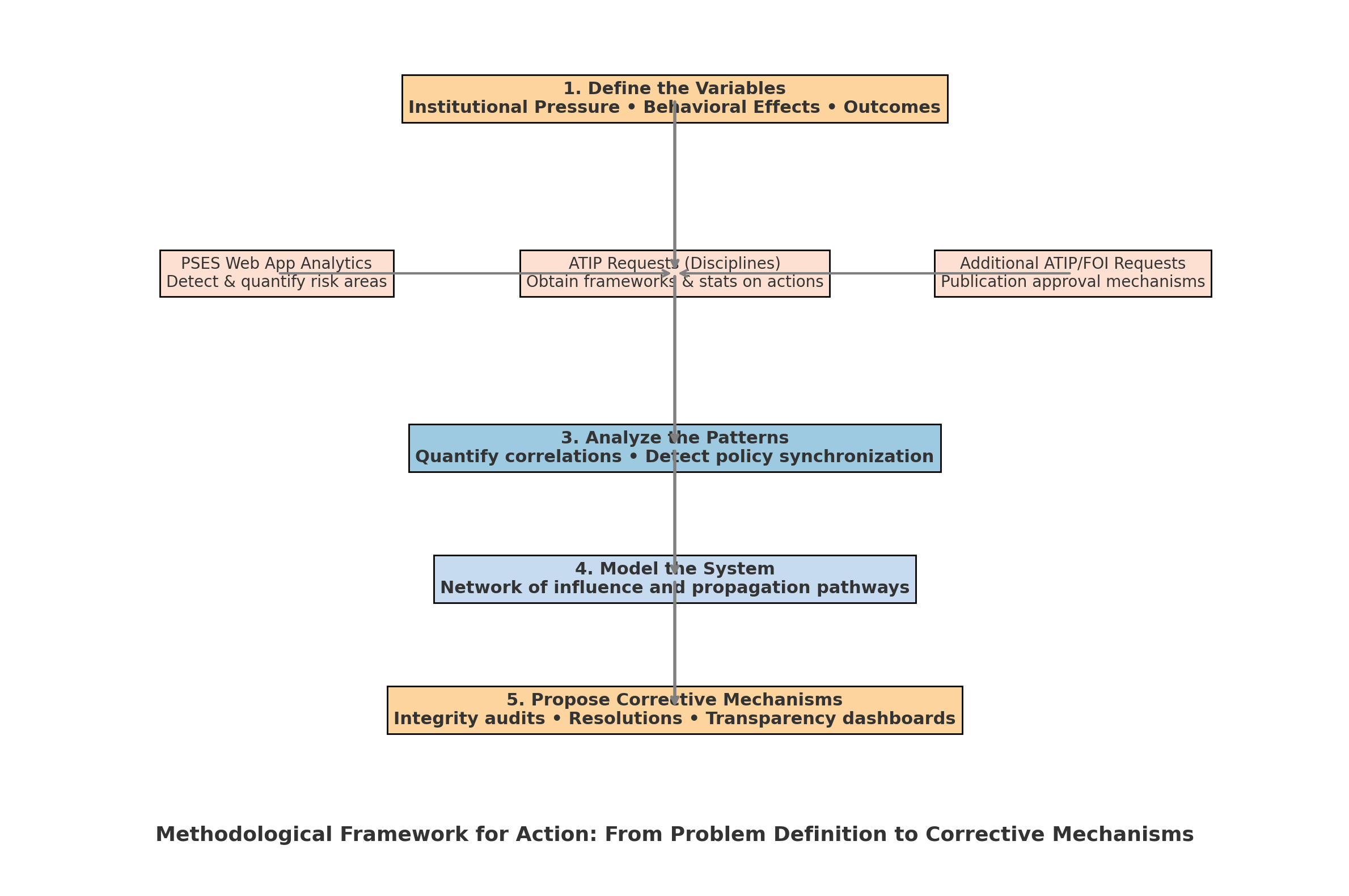
1. Define the Variables
The problem consists of three measurable components:
Institutional Pressure: political and industrial influence on internal decision-making.
Behavioral Effects: self-censorship and fear among professionals.
Outcomes: policy distortions and loss of scientific integrity in public communication.
2. Collect the Data
To understand the scale and mechanisms of political interference, I have initiated several data-gathering actions, combining analytical tools, transparency mechanisms, and access-to-information processes.
2-1 PSES Web App analytics - to detect and quantify risk areas
I am using the Public Service Employee Survey (PSES) web application that I developed several years ago to detect areas at highest risk for scientific integrity breaches.
This involves identifying organizational units where the fear of reprisal is disproportionately high and not correlated with harassment or discrimination indicators — a signal that professional expression may be suppressed for reasons unrelated to workplace well-being.
Particular attention is being given to branches involved in marketed health product evaluation and health policy development, where the risk of industrial influence is most acute.
To learn more about this effort and the insights gained to date, please visit:
https://en.gorodnichy.ca/evidence/fear-of-reprisal

2-2 ATIP (Access to Information and Privacy) Requests - on disciplines
I am filing targeted ATIP requests to obtain disciplinary frameworks, statistics on disciplinary actions, internal correspondence, and policies related to professional expression — especially within departments responsible for health product evaluation and policy oversight.
These requests aim to determine how internal governance mechanisms are applied when employees raise scientifically grounded concerns that may conflict with external industrial or political pressures.
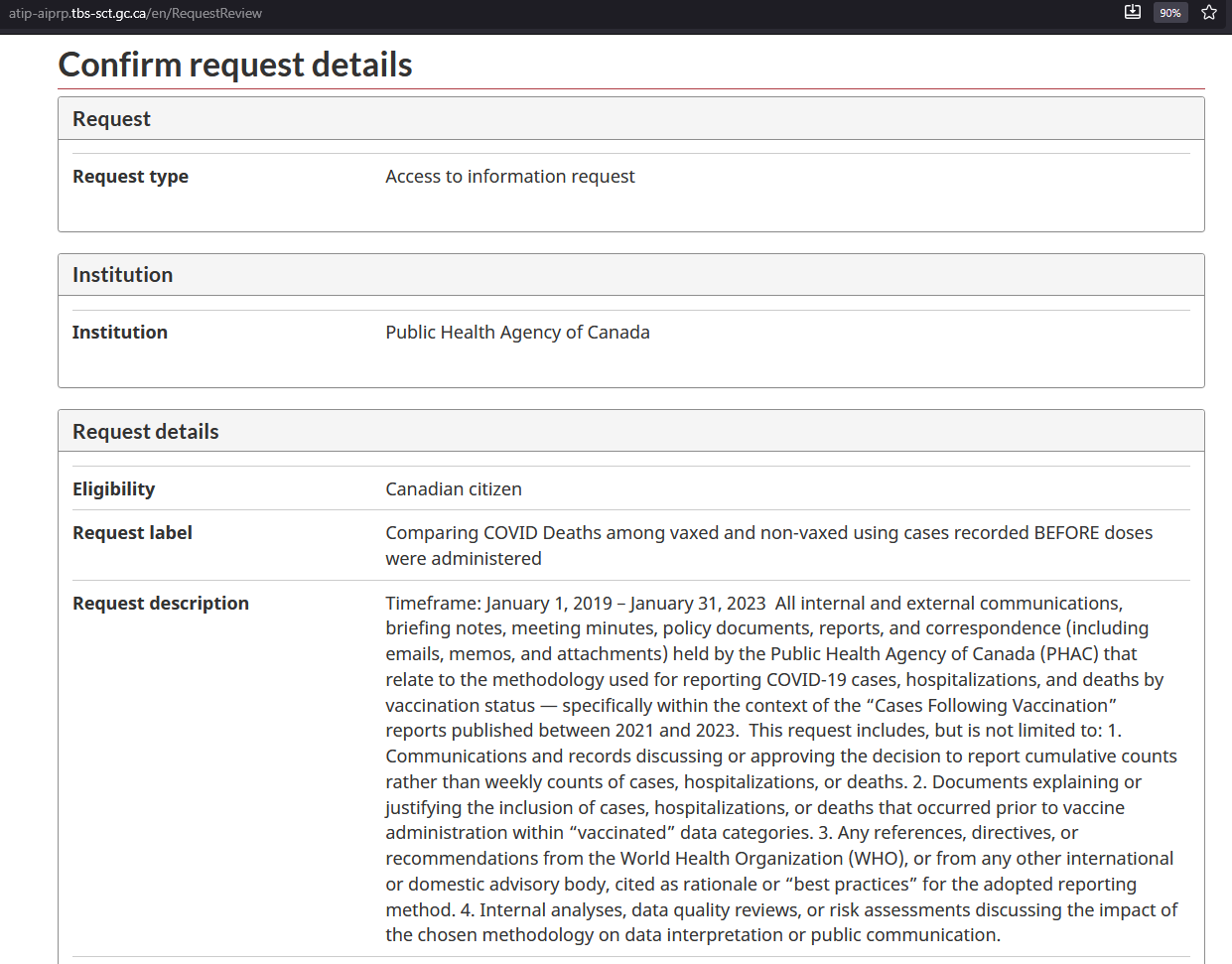
2-3 Additional ATIP / FOI Requests - on data reporting approval mechanisms
I am also seeking documentation behind high-impact public health communications — such as “Cases Following Vaccination” reports by PHAC — which exposed data-manipulating biases favouring specific pharmaceutical products.
As discussed in the IVIM Substack, the post-marketing data that was gathered in Canada since the start of COVID-19 vaccination never showed any evidence to support the widely circulated messages at the time that the “vaccinated” were less infected, less hospitalized, or died less frequently from COVID than the “unvaccinated.” However, what they did show was evidence that PHAC used a very strange way of reporting this data in graphs in such a way as to deliberately create an impression (or visual illusion) for lay readers (who do not have time to delve into all the technical details and instead skim through images and highlighted text only) that it does. This can hardly be perceived in any other way than as PHAC’s deliberate effort to “fit the evidence” to the predefined desired narrative, pointing to likely political interference within departments responsible for public health policy and pharmaceutical product evaluation, and correlating with units that report elevated fear of reprisals and lower satisfaction compared to the broader public service.
To learn more about this effort and the insights gained to date, please visit:
https://en.gorodnichy.ca/evidence/political-interference

Through these Freedom of Information requests, I intend to trace how decisions to publish such biased reports were made, who authorized them, and which expert advisory mechanisms (including those connected to international bodies such as the WHO) were cited to justify these highly contradictory and scientifically inconsistent reporting practices.
To learn more about ATIP requests filed and the insights gained to date, please visit:
The image below shows one of those requests.
3. Analyze the Patterns
Using these data sources, I aim to:
Quantify patterns of discipline or censorship linked to speaking out.
Identify correlations between internal pressure indicators and public communication trends.
Detect signs of policy synchronization, where identical language or decisions appear across departments or even countries.
4. Model the System
Once data are collected, it should be possible to uncover a network model of influence—similar in structure to the “System of Influence” diagram from the previous article.
This model will visually and quantitatively demonstrate how decisions propagate from industrial and political actors through bureaucratic layers to public communication.
5. Propose Corrective Mechanisms
The model will serve as an evidence-based foundation for:
Resolutions proposing safeguards against political interference.
Integrity Audits for policy development.
Transparency Dashboards showing how government decisions align with scientific recommendations.
Even if these resolutions are not yet reaching the floor, they mark the beginning of a corrective process—and a record of the effort to restore accountability.
Discussion: Union, Science, and Citizen Roles
It is deeply concerning that our union has shown little interest in investigating or defending members against political interference — beyond the scientific-integrity policy that PIPSC developed in 2018 for employees in the Research (RE) or Applied Science & Patent Examination (SP) occupational groups.
But change does not require permission — it requires persistence.
As union members, we can continue introducing resolutions that address the structural and cultural barriers preventing our professionals from speaking truth to power. These include:
Protection of professionals from reprisal for evidence-based statements.
Creation of independent review mechanisms for policy-science integrity.
As scientists, we can apply analytical rigour to identify and expose inconsistencies, omissions, and biases in public reports. It is our responsibility to ensure that decisions affecting the health and safety of Canadians are made transparently and in alignment with empirical evidence — not with industrial or political agendas.
As citizens, we must advocate for open and accountable governance that values truth above influence. This is not just a civic duty — it is a moral imperative.
I invite all of you — fellow professionals, union members, and citizens — to reflect on what you can do within your role. The ideas outlined above mean to serve directions for collective action. If you have additional ideas or initiatives that align with this goal, I welcome your input and collaboration.
In the meantime, I will continue logging my actions and planned initiatives on my Action Tracker within my electoral portal. Doing so helps me manage these efforts alongside the many other professional and personal projects I am engaged in.
I hope this public record will also inspire others to take initiative, and to hold accountable those who resist necessary change — to remind them that the union’s original purpose is to stand for its members, not for the employer or for the political or industrial agendas driven by the wealthiest corporate interests.
We now understand both where the interference originates and how it spreads. The next phase is to build systems of resistance — rooted in transparency, courage, and data-driven accountability.
If public institutions fail to defend truth, then it becomes our collective duty — as scientists, as union members, and as citizens — to rebuild that defense ourselves.
References
Breen, E. & Kumar, R. (2023). Private Foundations and Their Global Health Grant-Making Patterns. Global Policy Forum Europe.
Public Service Employee Survey (PSES), Treasury Board of Canada Secretariat.
Government of Canada (2025). Access to Information Act.
Reich, R. (2018). Just Giving: Why Philanthropy Is Failing Democracy and How It Can Do Better.
Disclaimer
This article’s opinions are those of the author, not of any institution. It is not for legal or medical advice.
Acknowledgment
This article was written with assistance from ChatGPT using the prompt:
“Write the third article in a data-scientist series on political interference, focusing on the methodological plan to address it through data analysis, transparency tools, ATIP requests, and union action.”
Based on approximately 1,500 words and 40 minutes of narrated input and collaborative drafting with the author. ChatGPT was used to ensure political neutrality, factual accuracy, and alignment with the Public Servant Code of Values and Ethics.
Read why and how I use ChatGPT.
Support This Work
If you believe in open dialogue, informed choice, and exploring underreported perspectives, please help keep this work going—like and share this article on your preferred platform.
I write these articles as a contribution to my community—especially for those seeking truth and integrity in public service. Your support through follows, likes, and shares makes a real difference.
You can follow me here:
🔹 LinkedIn
🔹 Facebook
🔹 Twitter/X
🔹 YouTube (@Dr.Dmitry.Gorodnichy)
🔹 YouTube (@IVIM)
The reason why I find your work so important is that it can inform us about who to trust to tell us the truth. If the average citizen has no idea what goes on within institutions, like government agencies, then they will simply accept what the institution says, without taking into account the possibility that the truth is somehow being suppressed. However, if they understand something about the truth suppressing processes at work within the institution they will adopt a more rational skepticism. Those who work within the institution will also develop a more rational skepticism.
I can see why a skeptic working within a government agency will be reluctant to speak out because of fear of reprisal. This isn’t necessarily moral failure. They may see that by speaking out the only result will be loss of their own credibility within the institution, plus the reprisal. What I wonder about is what is going on in the minds of those within a government agency who fail to become skeptical - who just don’t see that fear of reprisal is completely distorting the official claims put out by the institution. If you have some insight into why such people fail to become more skeptical, please write about it.