

La version française est disponible ici.
Vacations are over. We are back to work—and September promises to be an important month.
Yesterday, August 27, 2026, Call to Halt-19 announced that it is re-issuing its Open Letter calling for a halt to COVID-19 mRNA vaccines pending an independent and transparent scientific review.
I am one of the 86 signatories of this letter.
For me, this is important not only because of what the letter says, but because of what those signatures represent.
These are scientists, clinicians and other professionals willing to put their names publicly behind what they conclude from the evidence—knowing that questioning established government policy can sometimes come with professional consequences.
What Is Call to Halt-19?
The initiative was launched in March 2025 and is co-sponsored by the Canadian Citizens Care Alliance (CCCA) and RéInfo Québec.
Its Open Letter expresses what its authors describe as “extreme concern” regarding the quality, efficacy and safety of COVID-19 mRNA vaccines.
The letter calls for three principal actions:
an immediate halt to COVID-19 mRNA vaccines;
an independent and transparent public inquiry into the regulatory processes that led to their approval and continued use; and
further research into potential health risks.
The original letter discusses concerns including DNA contamination, batch inconsistencies and changes involving IgG4 antibodies, and provides scientific references supporting the arguments it asks authorities to examine.
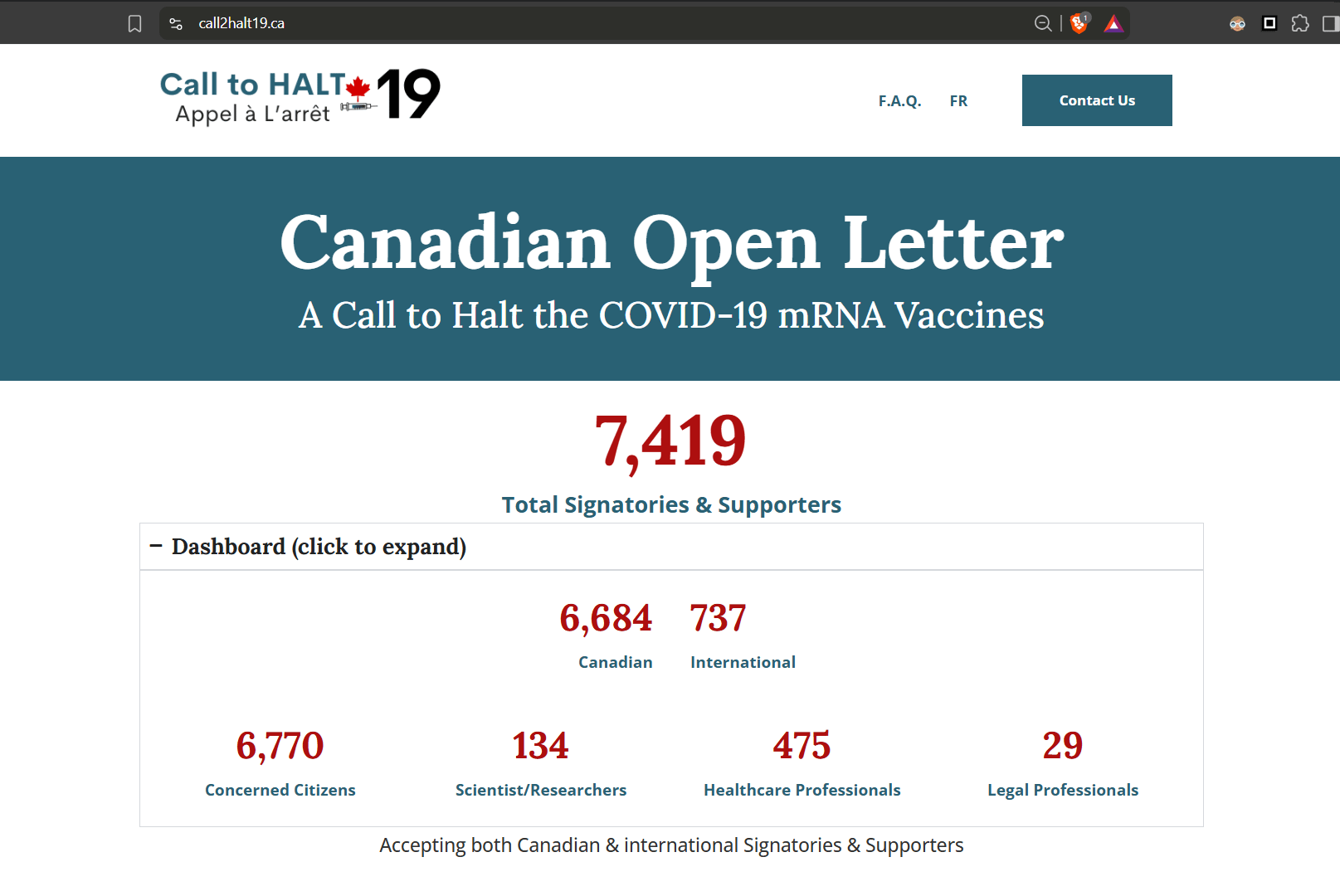
It has now been signed by 86 scientists, clinicians and other professionals and supported by more than 7,400 people across Canada.
Why Is the Letter Being Re-Issued Now?
According to the Call to Halt-19 organizers, the letter was sent last year to approximately 1,200 provincial, territorial and federal representatives and key public-health officials.
A year later, the organizers say they have received no substantive acknowledgement or response.
At the same time, additional scientific publications have appeared.
The 2026 update therefore brings forward additional concerns and references, including questions surrounding persistence of vaccine components in the body, possible biological mechanisms relevant to cancer, and the toxicity of lipid nanoparticles.
These are serious claims. They should be examined critically, including against contrary evidence.
But that is precisely the point.
Questions raised by scientists should be answered through evidence and open scientific discussion—not through silence.
This September: Putting the Evidence in Their Hands
The campaign is now moving into its next stage.
Beginning this September, Call to Halt-19 plans to mail the original Open Letter together with its 2026 update directly to more than 1,200 federal and provincial elected representatives and public-health officials across Canada.
CCCA is raising funds to cover this distribution.
According to its campaign, approximately $5 can help send the materials to two or three elected officials.
But putting a document on someone’s desk is only half of the effort.
The organizers are also asking Canadians to contact their own MPs and provincial representatives respectfully, explain why they believe these questions deserve attention, and direct them to the evidence and references contained in the Open Letter.
You can read the letter, examine its scientific references and add your name as a supporter at the Call to Halt-19 website.
And Then Comes the Allison Inquiry: September 8–11
The timing is particularly significant because another initiative begins only days later.
From September 8–11, 2026, the Allison Inquiry, chaired by MP Dean Allison, is scheduled to hear testimony from Canadians reporting injuries following COVID-19 vaccination.
CCCA is encouraging Canadians to respectfully ask their MPs and Senators to attend and listen to that testimony firsthand.
More information is available at CovidTestimony.com.
There is an extraordinary irony here which I have documented previously:
the portal providing access to this Inquiry has been blocked from the Government of Canada workplace network.

That means we are simultaneously asking elected representatives and public officials to examine evidence and testimony while at least some federal public servants attempting to access the Inquiry portal from their workplace computers have instead encountered a block page.
I believe that deserves an explanation.
Why I Put My Name on the Letter
For me, signing this letter was not an abstract gesture.
In February 2022, I made my own decision not to receive a second COVID-19 vaccine dose.
I made that decision after examining the information available to me, including official government data. My interpretation of those data led me to conclude that I was seeing evidence of potential health risks, while not seeing sufficient evidence to convince me that another dose would improve my own survival prospects or reduce transmission enough to justify those risks.
I also believed that if other people could see the same evidence I was seeing, many might reach the same conclusion. The problem, as I saw it, was that much of this evidence was not easily accessible to the public, and some of it, in my view, was being withheld or insufficiently disclosed.
If people examine the same evidence and reach a different conclusion, that is their choice—and that is something we can discuss and debate. That is how scientific discussion is supposed to work.
What matters to me is that people must remain free to examine evidence, question conclusions, discuss what they find, and put their names behind what they believe the evidence shows.
I knew that my decision could carry serious financial and professional consequences because it went against the government’s vaccination policy and public messaging at the time.
It did.
My decision first resulted in a prolonged period of leave without pay for non-compliance with the vaccination mandate. It was then followed by a series of disciplinary actions connected to my efforts to share and discuss with colleagues and the broader public the evidence I had examined—and ultimately by multiple grievances that I filed challenging those decisions.
One of those grievances has now been resolved in my favour.
Four remain.
But that story deserves its own article.
For details about my grievance hearings and the evidence I have gathered, please visit IVIM.ca/hearing.
September Is an Opportunity
The next few weeks give Canadians two opportunities to ask difficult questions through peaceful, evidence-based democratic processes.
Call to Halt-19 seeks to put its scientific arguments and references directly into the hands of more than 1,200 decision-makers.
The Allison Inquiry will give Canadians reporting vaccine injuries an opportunity to have their testimony heard.
People do not have to agree with every conclusion advanced by either initiative to recognize the value of examining evidence openly.
Read the Open Letter.
Check its references.
Read opposing evidence as well.
Ask questions.
Contact your representatives.
And, above all, defend the ability of scientists, professionals and ordinary Canadians to raise difficult questions without fear that asking them will itself become unacceptable.
That is how evidence should be tested.
And that is how science is supposed to work.
There are innumerable reasons to Stop the Shots: https://stoptheshots.ca
.
Good Luck The few scientists I know are cowards. Their children will feel the brunt.